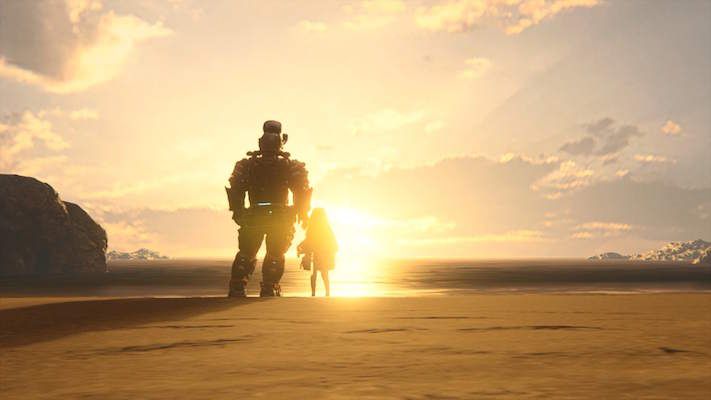
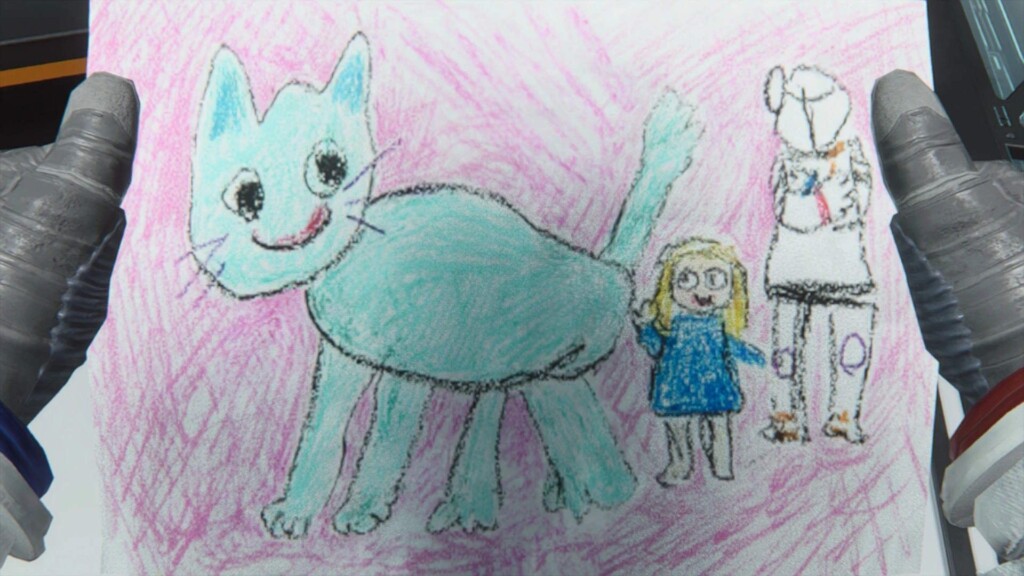
I can trace the exact instant Pragmata won me over. Hugh and Diana had just made their way back to the Shelter—a fragile sanctuary tucked inside the lunar installation known as the Cradle—when Diana suddenly announces she has something for him. From Hugh’s point of view, she darts off-screen, only to return moments later clutching a sheet of paper.
She’s drawn him a picture. A snapshot of something they’ve just lived through, reimagined through her eyes and offered up with an unfiltered, radiant smile. Hugh responds with a kind of warmth that feels almost overflowing, thanking her in a way that makes the moment land even harder than it should. From then on, Diana’s drawings sit pinned beside one of the Shelter terminals, quietly waiting to be revisited whenever Hugh returns.
It’s a small detail, but it lingers. Moments like this define their bond—so much so that you can even play hide and seek with her whenever you like—and that relationship becomes the emotional core of Pragmata. It’s not quite a traditional parent-child dynamic; it feels closer to a significant age-gap sibling bond. Still, it carries that same instinctive protectiveness. Diana, despite being an android, feels undeniably human in those exchanges. And as the journey unfolds, it’s easy to believe Hugh would move mountains, or anything worse, to keep her safe. Watching that connection evolve is quietly devastating in the best way.
Hugh may feel like he’s constantly moving mountains just surviving on the Cradle, but that’s where Pragmata’s combat system steps forward and demands attention. Capcom has long mastered third-person shooting mechanics, and that confidence shows here. Gunplay feels weighty but fluid, grounded but responsive. It isn’t the balletic chaos of something like Devil May Cry, but as the game progresses and Hugh’s kit expands, he begins to flow through encounters with a surprising grace—dashing across arenas like a skater carving through thin ice, slipping out of danger and striking back with precision.
What elevates the system is Diana’s hacking mechanic. Guiding a cursor through a grid to breach enemy defenses never settles into repetition, even when the same enemy type appears again. The grid may look familiar, but the paths it offers shift constantly, forcing you to improvise every time. Nodes scattered along the route add another layer of unpredictability, layering buffs and debuffs into the hack like puzzle pieces snapping into place mid-run. As long as you pass through them, their effects trigger—turning each route into a small, evolving strategy.
When larger enemies enter the fray, the grids expand in scale and complexity, and the tension spikes accordingly. Trying to complete a hack while dodging incoming attacks from all directions creates a constant push and pull between calculation and survival. It’s the kind of design that makes you mutter things you probably shouldn’t, only exhaling once the hack completes and you somehow survive the aftermath. That split-second relief is where Pragmata feels most alive.
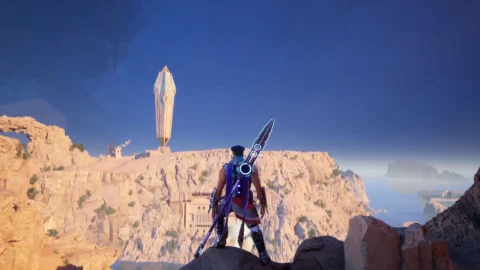
The Cradle itself is built like a place meant to be poked and prodded. Every zone branches outward from a main path, rewarding curiosity with meaningful finds: upgrade materials for Hugh, mods for Diana that reshape hacking (and are amusingly treated like they’re being consumed like juice boxes), training data for skill development, and more. One standout collectible is Cabin Coins, handed over to a small robot named Cabin and used to fill bingo-style reward boards—each square unlocking something new and worthwhile.
Death doesn’t reset progress so much as redirect it. You return to the Shelter, regroup, adjust your loadout, and jump back in near where you fell. Enemies respawn when you revisit, giving the structure a subtle looped rhythm that edges toward roguelike territory—though it never fully commits to randomness in the way traditional roguelikes do. It’s more structured repetition than chaos, a cycle that reinforces mastery rather than chance.
Playing Pragmata on the Nintendo Switch 2 adds another layer to the experience. I specifically chose the platform to see how Capcom’s new release would perform on the hardware, and overall, it holds up impressively well. Both docked and handheld modes maintain strong performance, with only occasional frame rate dips scattered across the roughly 12-hour experience.
The most noticeable issues appear in the forest section of the Cradle, where dense foliage seems to push the system hardest. Even then, the drops are brief and recover quickly, never truly breaking immersion or making the game feel unstable. It’s more a momentary stumble than a lasting problem.
What Pragmata ultimately feels like is a studio operating at full confidence. A new IP, new characters, and a hybrid combat system that blends shooting and hacking in ways that feel genuinely fresh in 2026’s landscape—it all comes together in a way that feels both bold and deliberate. Hugh and Diana’s relationship gives it heart, the combat gives it pulse, and the Cradle gives it scale. Capcom isn’t just experimenting here; it feels like they’re refining a new language. And by the end, you’re left wanting to draw something too.