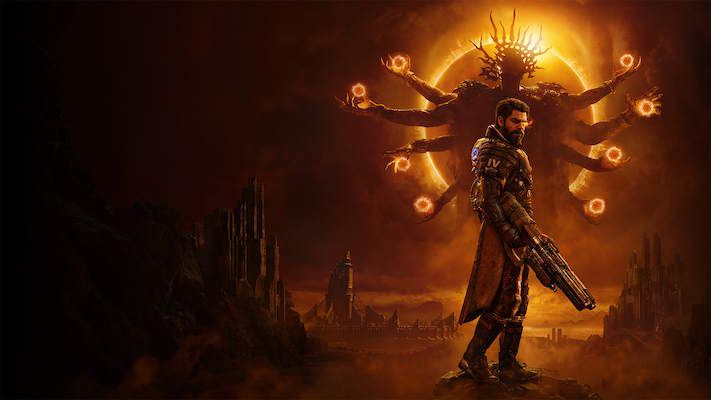
2021’s Returnal marked a striking evolution of the shoot-’em-up formula, fusing roguelike structure with AAA presentation to deliver hypnotic, high-intensity combat. Its narrative, centered on Selene’s looping descent into a hostile alien world and the psychological weight she carries, was just as memorable as its gameplay. Saros follows a similar lineage—refined, more fluid, mechanically sharper—but its narrative impact doesn’t quite burn with the same intensity as its predecessor.
At its core, Saros follows Arjun Devraj, a Soltari enforcer dispatched to the shifting, eclipse-struck world of Carcosa. Tasked with gathering resources for his organization, Arjun finds himself stranded on a planet that refuses to stay stable for long. Its cycles of darkness and light reshape the environment, while his Echelon IV crew slowly fractures into something resembling a cult-like collapse. Somewhere within this unraveling descent lies Nitya, a mysterious figure tied to the planet’s deeper secrets.
The early mystery—centered on missing crewmates and fractured transmissions—lands with real intrigue. Unlike Returnal, which leaned heavily into isolation and existential dread, Saros initially feels more populated, more conversational, and less suffocating. That shift gives it a more grounded tone, though it also dilutes some of the oppressive atmosphere that defined its spiritual predecessor. As the story pivots toward Arjun’s internal struggles, momentum begins to waver, and the sci-fi thread that once felt gripping starts to fade into the background.
Still, Rahul Kohli’s performance as Arjun Devraj anchors the experience with forceful conviction. His voice carries a persistent edge—equal parts anger, exhaustion, and determination—making each repeated death and restart feel like part of an ongoing emotional pressure cooker rather than a reset button.
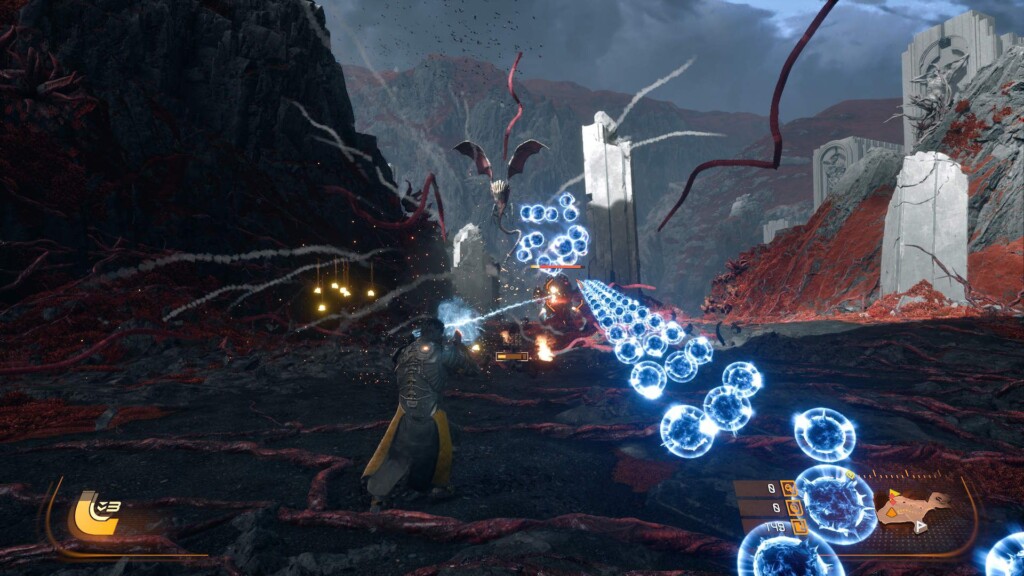
Where Saros truly excels is in motion, combat, and systems design. Traversing Carcosa’s shifting biomes feels like stepping into a living bullet ballet, where survival depends on reading chaos in real time. Enemy attacks are color-coded with clarity: blue projectiles can be absorbed and converted into energy for power weapons, while red attacks demand precise evasion or timed counterplay. The result is a rhythmic, almost musical loop of movement, timing, and aggression.
Every encounter becomes a test of awareness. Threats arrive from multiple angles, platforms crumble under missteps, and split-second decisions determine survival. It is overwhelming by design—but when a room finally clears, the payoff feels earned, almost euphoric.
Progression is driven by a constant stream of randomized upgrades: weapons, abilities, and power tools that reshape each run. No two attempts feel identical, forcing adaptation rather than optimization. A shotgun may replace a rifle, and suddenly the entire rhythm of combat shifts toward close-quarters survival. Flexibility is not optional—it is survival itself.
The roguelike structure has also been streamlined compared to Returnal. Death still resets progression, but onboarding is smoother and more forgiving. The introduction of the Autohit system—an automatic targeting assist embedded in starting weapons—reduces early friction and helps players acclimate before diving into more demanding builds. Even on death, continuity is preserved by carrying forward previously used weapons, albeit in weakened form.
This creates a more approachable loop, and for many players, a more sustainable one. Builds become less about perfection and more about comfort, with players naturally gravitating toward weapons and traits that match their preferred rhythm.
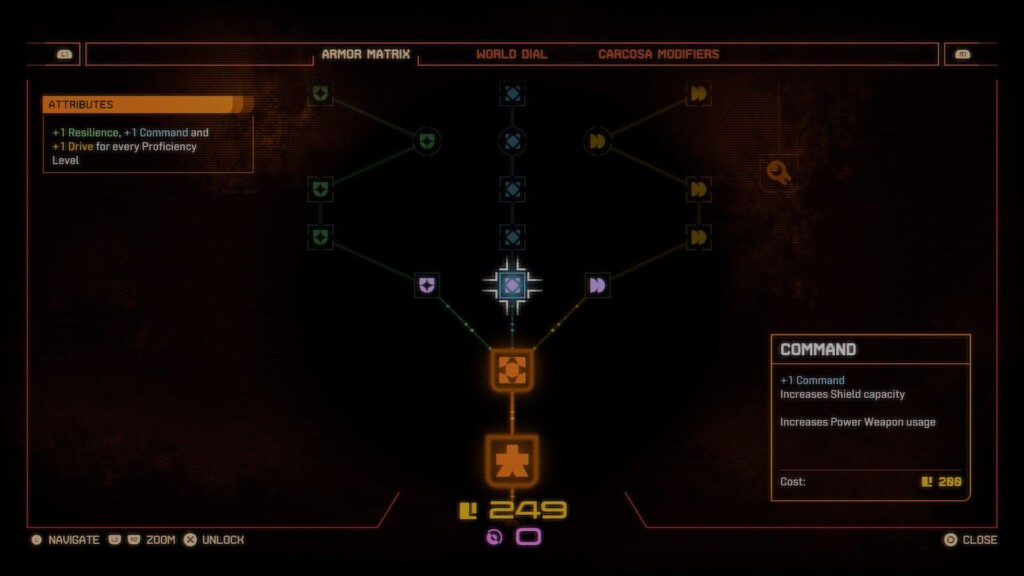
Further structure comes from the Armor Matrix, a persistent upgrade system that allows players to invest earned resources like Lucinite and Halcyon into long-term enhancements. Increased health, stronger shields, and improved starting conditions ensure that even failed runs contribute meaningfully to future progress. Compared to Returnal, this system offers a clearer sense of accumulation and growth, even in defeat.
Biome design has also been reworked. Instead of forcing linear progression through earlier zones, players can now directly access later biomes once unlocked. This dramatically shortens run length and reduces fatigue, though it slightly weakens the escalating tension of traditional roguelike structure. Each biome now feels more self-contained—less like a journey, more like a curated challenge space.
Mid-run difficulty spikes come from Alpha enemies—enhanced variants of standard foes that can appear alongside regular threats. These encounters inject unpredictability and often destabilize otherwise controlled situations, preserving the game’s challenge despite its more forgiving structure.
A major structural twist arrives with the Eclipse mechanic, transforming Carcosa into a corrupted, yellow-suffused battlefield. This altered state introduces more aggressive enemies alongside powerful but risky pickups that enhance Arjun’s capabilities while applying meaningful drawbacks—reduced damage under certain conditions, weakened healing effects, and other tradeoffs that force constant evaluation. Every advantage comes with a cost, and that tension becomes central to decision-making.
Run customization extends further through optional modifiers applied before each cycle. These allow players to tailor difficulty and reward balance, mixing beneficial effects with self-imposed handicaps that shape the experience in meaningful ways. The system encourages experimentation while maintaining strict balance constraints, ensuring that no combination trivializes the challenge.
In the end, Saros feels less like a departure and more like a refinement of Returnal’s foundation. It tightens systems, smooths friction, and expands accessibility while preserving the core identity of relentless bullet-hell survival. Its story may lose momentum in its later stages, but its gameplay loop remains consistently sharp, addictive, and punishing in all the right ways.
Housemarque has not reinvented the formula—it has sharpened it, polished it, and set it ablaze under a shifting yellow sky.